Clintonville Investment Property Analysis for Small Landlords
May 14, 2026
May 14, 2026
If you are thinking about buying a rental in South Clintonville, the first question is simple: will the numbers actually work? In a mature Columbus-area neighborhood, that answer usually depends less on chasing a bargain and more on choosing the right property type, location, and operating plan. This guide will help you screen opportunities, understand local market signals, and focus your due diligence before you make an offer. Let’s dive in.
South Clintonville sits in a well-established part of Columbus, roughly 3.5 miles north of downtown and just north of the University District. Public planning data for this area is typically reported at the broader Clintonville or 43214 ZIP level, so those are the best local proxies for small-landlord research.
That broader Clintonville profile points to a stable housing mix. Columbus Planning estimates 16,142 housing units, with 58.5% owner-occupied, 37.0% renter-occupied, and 4.4% vacant. The same profile estimates a median household income of $97,845, an average household income of $126,846, and an average home value of $387,616.
For a landlord, that matters because this is not a fast-turnover rental pocket built around constant churn. It looks more like a mature, established market with a meaningful renter base, steady daytime activity, and neighborhood amenities that support long-term demand.
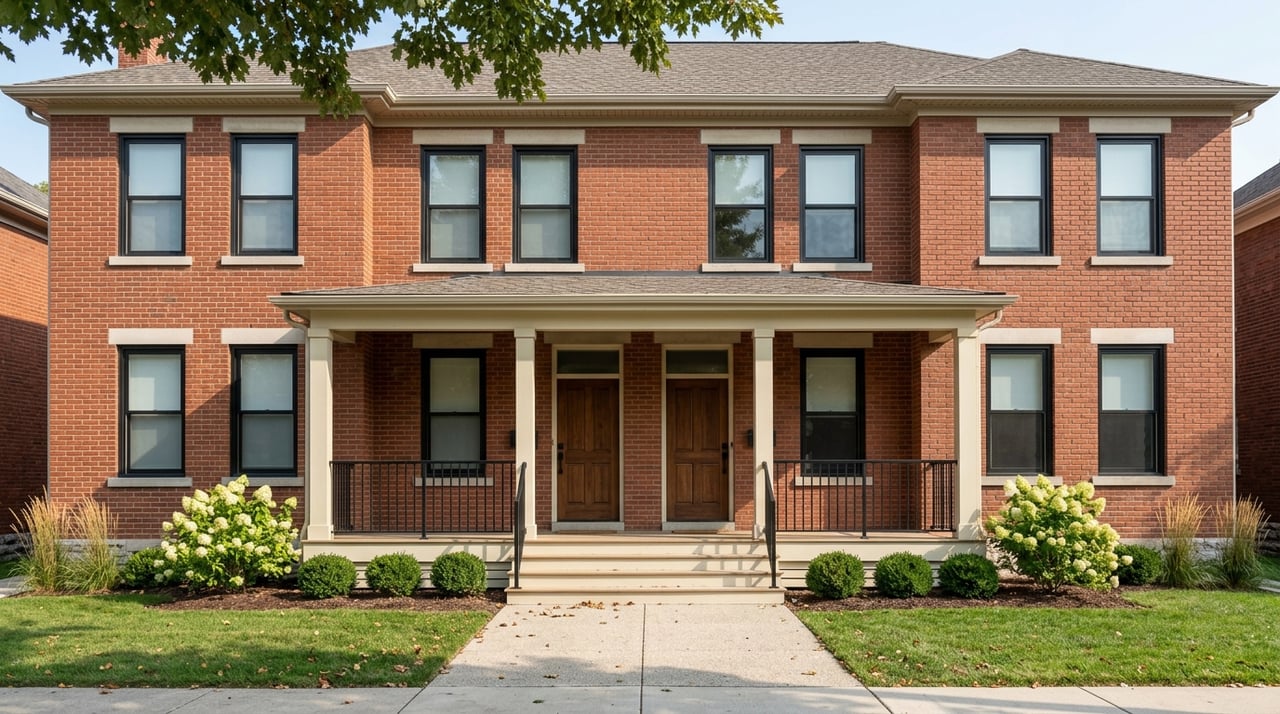
Property type matters a lot in Clintonville. The neighborhood plan says existing land use is about 60% single-family, 6% multifamily, and 3% two- or three-family, while existing zoning is about 85% single-family and 6% multifamily.
In practical terms, most interior streets still function like classic neighborhood housing. Multifamily uses are concentrated more heavily along High Street, with notable multifamily areas north of Graceland Shopping Center and at Olentangy Village.
The city’s planning framework also points future higher-density housing toward High Street and, to a lesser extent, Indianola Avenue. Duplexes, three-family homes, and quad-style properties may be considered in some subareas, but the general pattern is clear: corridor-adjacent properties are usually the more natural fit if you want stronger income-property economics.
If you are buying your first investment property, it is easy to assume a single-family home will be the safest option. In South Clintonville, that may feel familiar, but it does not always create the strongest return on paper.
Current public listing data in 43214 still shows small multifamily inventory, including duplex, triplex, and larger small-building opportunities. That matters because the math often improves when you can spread vacancy risk and fixed costs across more than one unit.
A useful way to think about the area is this:
Zillow’s 43214 rental market data, updated May 6, 2026, shows a blended average rent of $1,428. It also reports average rents of $1,286 for one-bedroom units, $1,395 for two-bedroom units, and $2,000 for three-bedroom units.
That same source describes the market as warm and shows 37 available rentals. On the ownership side, Zillow’s 43214 home-value page, updated March 31, 2026, shows a typical home value of $402,925, with 35 homes for sale, 19 new listings, and a median time to pending of 10 days.
Taken together, those numbers suggest a relatively tight market. For small landlords, that can support demand, but it can also mean acquisition pricing stays firm.
Before you spend time on full underwriting, it helps to run a fast gross-yield screen. This is not your final investment analysis, but it can help you rule out weak deals quickly.
Using the Clintonville average home value of $387,616 and the 43214 average rent of $1,428, the gross yield comes out to about 4.4%. That is a useful reality check for investors hoping a typical single-family purchase will hit aggressive cash-flow targets.
The classic 1% rule is also hard to reach here. On a $387,616 property, you would need roughly $3,876 per month in rent to hit that benchmark, which is not realistic for most Clintonville single-family acquisitions at current pricing.
Suppose you found a duplex priced at $436,200. If each unit rented at the 43214 two-bedroom average of $1,395, total monthly rent would be $2,790.
That produces a gross yield of about 7.7% before vacancy and expenses. It is still only a first-pass screen, but it shows why small multifamily can look more attractive than single-family in this market.
Now suppose you found a five-family building priced at $677,700. If all five units rented at the same $1,395 benchmark, monthly gross rent would be $6,975.
That works out to a gross yield of about 12.4% before expenses. Again, this is not net return, but it does show how a higher unit count can change the investment picture.
Strong gross rent does not automatically mean strong cash flow. Your real return will be pulled down by property taxes, insurance, maintenance, turnover, vacancy, and any management costs.
That is especially important in a mature area like South Clintonville, where pricing can be firm and many buildings may be older. A deal that looks good at a glance can tighten quickly once you plug in realistic operating costs.
Before you buy, pressure-test these line items:
Franklin County property taxes should be reviewed at the parcel level, not by rough county average. The Franklin County Auditor says Ohio real-property taxes are based on appraised value multiplied by the district’s effective rate, and the county is in a 2026 triennial update cycle.
That means a tax estimate pulled from a generic calculator may miss the mark. For underwriting, use the actual parcel tax bill or the auditor’s estimate tied to that specific property.
Utilities deserve the same level of attention. In Columbus, water and sewer service can be placed in a tenant’s name through a Tenant Billing Agreement, but the city says the owner remains ultimately responsible for unpaid charges.
Ohio landlord-tenant law includes a few rules every small landlord should build into their process. Under ORC Chapter 5321, security-deposit deductions must be itemized and the deposit must be returned within 30 days after move-out.
There is also an interest rule that can catch newer landlords off guard. Deposits above $50 or one month’s rent accrue 5% annual interest on the excess after six months of tenancy.
These are not complicated rules, but they are easy to mishandle if you are self-managing. Clean recordkeeping and a repeatable move-in and move-out system can save you time and stress.
Because Clintonville is a built-out, established neighborhood, many properties may need closer inspection than a newer suburban rental. Age alone does not make a property a bad investment, but it does mean your inspection process should be more thorough.
If the property was built before 1978, lead-based paint risk should be part of your diligence. Columbus notes that Lead Safe Columbus helps eligible property owners address lead-based-paint hazards in single-family and multifamily units.
You should also pay close attention to plumbing and service-line issues. The city is running a lead-service-line replacement program, but private-service-line leaks may still remain the owner’s responsibility until the street is reached.
If your plan involves more than basic cosmetic work, verify the permit path early. Columbus requires multifamily building permits for properties with four or more units.
Some parts of High Street and Indianola also have zoning overlays with added design-related standards. In certain cases, historic districts or commission areas may require a Certificate of Appropriateness before permits are issued.
For a small landlord, this matters most when you are considering a conversion, major rehab, or unit reconfiguration. What looks straightforward on a listing sheet may involve added time and approval steps.
When you are comparing opportunities in South Clintonville, keep your screening process simple and consistent. The goal is not to know everything on day one. The goal is to avoid expensive surprises.
Start with this checklist:
In South Clintonville, the better opportunity often comes from alignment, not hype. The property should fit the local planning pattern, the unit mix should match local rent demand, and the price should leave room for real operating costs.
That usually means being careful about overpaying for single-family homes if your main goal is income. It can also mean paying closer attention to duplexes and small multifamily properties near the corridors where that housing type already fits the neighborhood pattern.
The area’s walkability, transit access, bicycle connections, and established amenities can all support demand. But your deal still has to work after taxes, maintenance, and vacancy are factored in.
If you want help sorting through South Clintonville opportunities, pricing rent comps, or pressure-testing a deal before you move forward, the Richmond Home Team can help you evaluate properties across the Columbus metro with a local, numbers-first approach.
Stay up to date on the latest real estate trends.
If you're in the market for a new home, looking to sell your current home, looking for an investment property, or all of the above, let us be your guides to help you make that dream come true!
Get In Touch With Our Team To Learn More
5400 Frantz Rd. Dublin, OH 43016